

Why ITAD Services Matter More Than Recycling Alone
Not all recyclers are designed to protect your data. Learn why certified ITAD services go beyond scrap-yard drop-offs.
The Hidden Risk in “Just Recycling”
In today’s rapidly evolving technological landscape, businesses face a critical challenge: what to do with outdated or surplus IT equipment. Understanding the difference between IT asset disposition vs recycling is essential. While traditional recyclers focus only on materials, certified ITAD providers like Electronic Asset Security safeguard your data, ensure compliance, and maximize the value and sustainability of every retired device.
According to IBM’s Cost of a Data Breach Report, the average global cost of a data breach reached $4.45 million in 2023.
One improperly handled hard drive could expose sensitive data and cost your organization millions.
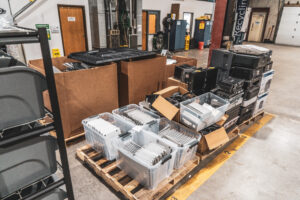
What Are IT Asset Disposition (ITAD) Services?
ITAD encompasses the secure, compliant, and sustainable management of retired technology assets — from collection and transport to data destruction, refurbishment, recycling, and reporting.
The scope of ITAD extends to virtually all business technology:
- Desktops and laptops
- Servers and data center equipment
- Networking and telecommunications hardware
- Mobile devices and tablets
- Printers, peripherals, and storage media
As the average lifecycle of IT hardware continues to shorten, organizations face growing volumes of decommissioned devices — and increasing risk if they rely solely on non-certified recyclers.
How ITAD Differs from Recycling
|
Recycling |
|
Focus on valuable material recovery only |
|
Often lacks secure chain-of-custody |
|
Focuses only resale of assets and commodities |
|
Prioritizes volume over security or sustainability |
|
Limited documentation with no verification |
|
Certified ITAD |
|
Focus on data security, compliance, and sustainability first, recycles all waste |
|
Tracks every data-containing asset and focus material category from pickup to final disposition |
|
Prioritizes data security by always following NIST 800-88 and DoD 5220.22-M standards for data destruction, recycles even negative-value commodities with other certified downstream vendors |
|
Prioritizes verification and accountability first while still ensuring responsible recycling |
|
Provides Certificates of Destruction and Recycling backed by an audited certification |
While e-waste recyclers may offer data destruction, it may not be backed by a certified process. Simple recyclers typically focus only on positive-value material recovery and often dispose of negative-value assets in the dumpster. EAS’s R2v3-certified ITAD process ensures that every data-bearing device is tracked, securely destroyed, sanitized, and then all waste is recycled in a responsible way, even if the cost is higher to do so.
Learn more about proper e-waste management from the EPA and UN Global E-waste Monitor.

The Critical Components of ITAD
1. Secure Data Destruction
Data security is the heart of ITAD. Certified providers like Electronic Asset Security employ multiple destruction methods:
- Data wiping/sanitization – Software overwriting and independent verification compliant with new NIST 800-88 standards.
- Physical destruction – In house hard drive and flash media shredding.
- Cryptographic erasure – Private key destruction for encrypted data, often followed up with physical destruction.
Each process is documented and verified for accuracy. EAS provides Certificates of Destruction with serial-number tracking, timestamps, and technician credentials — backed by an independently audited certification, ensuring full compliance with HIPAA, GLBA, FERPA, and other data-protection regulations.
2. Environmental Compliance and Sustainability
Electronic waste is the fastest-growing waste stream globally, with over 57 million metric tons generated annually, according to the UN Global E-waste Monitor.
Certified ITAD providers help mitigate that impact through:
- R2v3 certification – Ensuring responsible recycling through vetted processes and downstream vendor auditing to ensure that once waste leaves our facility, it continues to be handled responsibly.
- ISO 14001 alignment – Environmental management and pollution prevention
- Zero-landfill policies – EAS recycles everything possible — even when it incurs a cost. Ask your current recycler what they do with plastics.
By choosing certified ITAD, businesses meet environmental laws such as the Resource Conservation and Recovery Act (RCRA) and the Basel Convention, while demonstrating measurable ESG progress.
3. Asset Value Recovery
Not every retired device is worthless. Once an asset has been cleared of data, it undergoes secure refurbishment, remarketing, or parts harvesting. While recycling is a good end for most equipment, it is far more energy efficient to repair and reuse equipment.
EAS identifies functional equipment for reuse or resale, helping offset recycling costs and sometimes generating a positive return. This supports circular-economy principles and reduces e-waste.
4. Chain of Custody & Reporting
From the moment EAS technicians collect equipment, assets remain traceable within a documented chain of custody. Audit reporting includes:
- Serial-number and model tracking
- Verified handling and transfer records
- Certificates of Destruction or Recycling
- Environmental impact summaries
This level of transparency protects clients during audits and supports compliance with frameworks like NIST, ISO, and NAID AAA standards.

Why Professional ITAD Services Matter
Risk Mitigation
Improper disposal creates significant regulatory, financial, and reputational risk.
Without certified handling, devices could leak data, violate data-protection laws, or reappear in resale markets without proper sanitization. ITAD eliminates those risks through secure, auditable processes.
Resource Optimization
Building an in-house disposal program requires secure facilities, trained staff, and specialized equipment — an inefficient investment for most businesses. Partnering with a professional ITAD provider like EAS offers scalable, compliant solutions without costly overhead.
Sustainability & Corporate Responsibility
ESG-focused companies are expected to prove their sustainability commitments. Certified ITAD services demonstrate measurable progress by:
- Extending product lifecycles
- Reducing landfill waste
- Documenting carbon and material offsets
These initiatives reinforce brand reputation and meet stakeholder expectations for responsible technology management.
Selecting the Right ITAD Partner
When evaluating ITAD providers, look for:
- Certifications – R2v3, ISO 9001/14001/45001, eStewards, or NAID AAA
- Security protocols – Controlled access, 90-day surveillance, employee background checks, and drug tests are a minimum.
- Chain-of-custody documentation – Asset-level reporting and tracking to ensure that assets never leave trusted hands.
- Value recovery programs – Transparent remarketing and revenue sharing for qualifying equipment.
- Local accountability – Local, Iowa-based processing, not outsourced overseas. This saves logistics costs and those saving are passed on to the customer.
EAS is Iowa’s only R2v3-certified ITAD provider, combining security, sustainability, and local service — backed by globally recognized standards.
The Future of ITAD
As data-privacy laws tighten and e-waste volumes surge, ITAD is evolving to include:
- Integration with IT Asset Management (ITAM) for seamless lifecycle visibility
- Advanced automation for asset tracking and reporting
- Circular economy alignment, prioritizing reuse over destruction
Organizations that implement certified ITAD programs today will be better equipped to meet tomorrow’s compliance and sustainability demands.
Conclusion: Responsible Retirement Starts Here
Your technology’s lifecycle doesn’t end when you unplug it. Without proper ITAD, your data, compliance, and reputation remain at risk.
Electronic Asset Security goes beyond recycling — delivering certified ITAD solutions that protect your information, recover value, and safeguard the environment.
📞 Learn more: www.ElectronicAssetSecurity.com
📧 Contact us for a secure ITAD consultation today.